
Primary question: Can your teaching stack rely on a brand-new agent-session runtime with PostgreSQL persistence and provider-neutral tools?
RepoDaily adoption score
RepoDaily rates this as 92/100 (strong) for adoption: evidence, installation path, production risk, differentiation, license clarity, and AI/agent fit are scored from the article sources and adoption notes.
6 source(s) across 3 source category/categories, plus a RepoDaily-specific evidence module when available.
6 workflow step(s), 5 next-action step(s), and 5 command/install signal(s) were detected.
Trending momentum is +907 stars, with maintenance/release/issue signals counted when present.
Risk is marked medium, with 5 security note(s) and 4 explicit skip condition(s).
3 opportunity lens item(s), 4 alternative(s), and 4 type-specific section(s) support differentiation.
License source or license wording is present.
7 AI/agent-related signal(s) were detected in the article text and metadata.
Project overview
THU-MAIC/OpenMAIC is an open-source multi-agent interactive classroom written in TypeScript and released under the MIT License. The pitch is blunt: one prompt in, a whole course out. Version 1.0.0, shipped August 27, 2026, keeps the classic one-click generator and adds a Pro workbench — a chat-first space where an agent plans the curriculum, builds and revises every page, and works directly from materials you upload.
Under the hood, the README badges pin a current stack: Next.js 16, React 19, TypeScript 5, Tailwind CSS 4, and LangGraph 1.1 for agent orchestration. The release that matters most is the durable agent runtime: server-backed course-building sessions with a background session runner (#1169), agent session and owner event streams (#1170), and session lifecycle routes (#1171). Sessions survive restarts, accept follow-up steering mid-build, can be cancelled, and stream a replayable event transcript. Persistence is pluggable, built on an agent-session store with a PostgreSQL backend over layered contracts (#1163).
The tool layer is deliberately provider-neutral. Image, video, and ASR models resolve from server config (#1175); a missing key forces that capability off uniformly instead of breaking the build (#1181); startup validates model routing (#1182); and vendor identity is scrubbed from tool results (#1231). The validated tools include web_search (#1185), fetch_url behind a URL trust gate (#1190), material read/search (#1192), stage read/patch (#1194), page generation and deck editing (#1198), roster and voice registration (#1201), and image/video/PPTX import (#1211). A skills system (#1189) ships with Feynman and spiral curriculum methods (#1240), managed from Settings.
Traction is real for a young project: 907 stars and the #4 trending spot on 2026-08-30, a JCST'26 paper (DOI 10.1007/s11390-025-6000-0), a live demo at open.maic.chat, and a Deploy-with-Vercel button that clones the repo with .env.example pre-linked — one LLM key is enough to start, and every provider is optional. Local-first options include Lemonade for local AI, FunASR for local ASR, an OpenClaw integration section, and VoxCPM2 for voice, with community channels on Discord and Feishu.
Why it is trending now
- v1.0.0 landed August 27, 2026 — days before this trend window — packing the agent workbench, durable runtime, tool layer, and skills system into one release.
- 907 stars and rank #4 for 2026-08-30, immediately after the first stable major version.
- The Deploy-with-Vercel button plus a single optional key (OPENAI_API_KEY or ANTHROPIC_API_KEY) removes the usual setup tax.
- Academic grounding: a JCST'26 paper and the Tsinghua University lab org THU-MAIC behind the code.
- Local-first hooks — Lemonade Local AI, FunASR ASR, VoxCPM2 voice — speak directly to self-hosters who keep media processing on their own hardware.
Problem it solves
- Writing a course means rebuilding pages, decks, quizzes, and voice roles for every cohort — slow, repetitive authoring.
- A single chat reply is not a course: structured teaching needs stages, a roster of agents, registered voices, and editable decks.
- Most AI course tools bind you to one vendor's models and cloud, with no clean way to mix providers or run parts locally.
- Browser-based generators lose state when the tab or server restarts; OpenMAIC sessions are built to survive restarts and replay.
How it works
- Deploy via the README's Vercel button (framework=nextjs, env template pre-linked) or clone locally: Node.js >= 20.9.0, pnpm, then `pnpm install`.
- Copy `.env.example` to `.env.local`, add at least one provider key — the deploy template marks all providers optional — and start with `pnpm dev`.
- Enter one prompt on the home page: classic mode generates the whole course in a click; Pro mode opens the chat-first agent workbench.
- The agent plans the curriculum and calls validated tools — stage read/patch, page generation and deck editing, roster and voice registration, image/video/PPTX import.
- Uploaded materials reach the agent through material read/search and a fetch_url tool gated by the URL trust gate (#1190).
- Sessions persist in the PostgreSQL-backed agent-session store; steering, cancellation, and a replayable event transcript are session-level operations (#1167–#1171).
Product demo and interface preview

Architecture read: what v1.0.0 is actually built on
The front end is Next.js 16 with React 19, TypeScript 5, and Tailwind CSS 4; LangGraph 1.1 handles agent orchestration. That makes OpenMAIC a standard Next.js deployment target — the Vercel button ships framework=nextjs — rather than a bespoke runtime.
The changelog's layering is unusually clean for a 1.0: a driver model contract and stage route dialect (#1165), runtime foundations on the agent-session store (#1167), a background session runner (#1169), agent session and owner event streams (#1170), and session lifecycle routes (#1171). Persistence sits behind layered contracts with a PostgreSQL backend (#1163) and an ownership scope on stage documents.
Capability routing is config-driven: image, video, and ASR models resolve from server config (#1175), model routing is validated at startup (#1182), and agent tools enforce provider force-off with vendor identity scrubbed from results (#1231).
Command surface: verified local setup
- Prerequisites from CONTRIBUTING.md: Node.js >= 20.9.0, latest pnpm, and a `.env.local` copied from `.env.example`.
- Clone and install: `git clone https://github.com/THU-MAIC/OpenMAIC.git`, enter the directory, run `pnpm install`.
- `cp .env.example .env.local`, edit in your API keys, then `pnpm dev` for the development server.
- Pre-PR checks that mirror CI: `pnpm format`, `pnpm lint --fix`, `npx tsc --noEmit`.
- Branch naming follows convention: `feat/`, `fix/`, `docs/`; every PR must reference an issue with `Closes #123`.
Integration surface: what it plugs into
- Vercel one-click deploy with `OPENAI_API_KEY` / `ANTHROPIC_API_KEY` listed in the env description — all providers optional.
- A Lemonade Local AI section in the README for running models locally.
- A FunASR section for local ASR, keeping speech recognition off third-party clouds.
- An OpenClaw integration section for connecting the classroom to external agents.
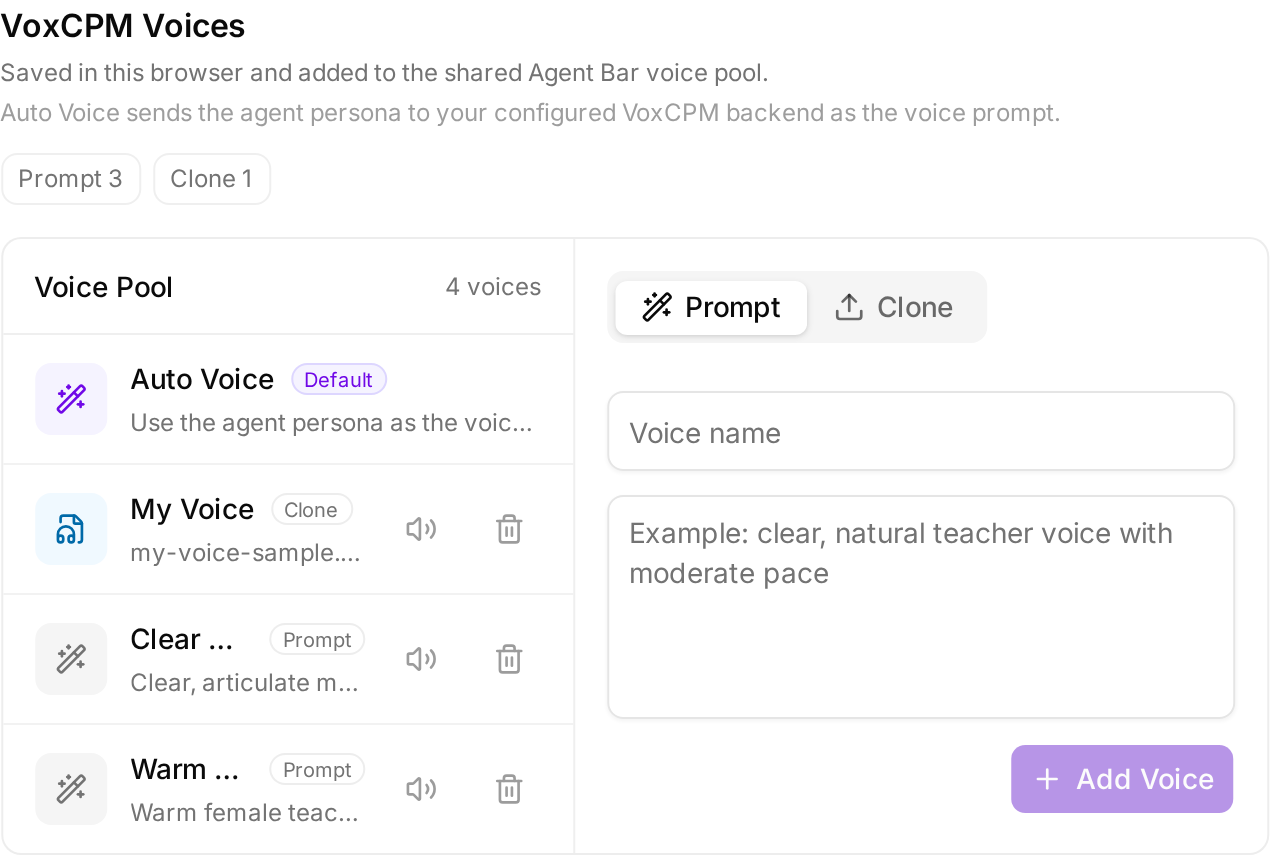
- VoxCPM2 voice: the README settings panel exposes a backend selector, Base URL, and model, with Auto, Prompt, and Clone voice modes.
Maintenance risk: a three-day-old 1.0
- v1.0.0 (2026-08-27) consolidates roughly thirty linked PRs from #1163 to #1244 — high merge velocity compressed into one release.
- SECURITY.md supports only `main` and the latest release; older versions receive no security fixes, so self-hosters must stay current.
- Vulnerability handling is private-first: GitHub Security Advisories, 48-hour acknowledgment, and a public advisory with researcher credit after patching.
- Refactor-only PRs are rejected unless a maintainer requests them, and feature work starts in Discussions or Discord — a deliberately guarded architecture.
Who should pay attention?
Good fit if
- Instructors and trainers who want courses generated from their own materials, including PPTX, image, and video imports.
- Self-hosters who mix providers: one vendor for text, local FunASR for speech recognition, VoxCPM2 for voice.
- Anyone who needs resumable agent sessions — steering, cancellation, replayable transcripts — rather than one-shot generation.
- Groups standardizing on Next.js who want a TypeScript 5, MIT-licensed codebase they can read and extend.
Skip for now if
- Anyone needing long-support stability: v1.0.0 shipped August 27, 2026, and only `main` plus the latest release get security updates.
- Buyers of managed LMS features — SSO, compliance, hosting — this is a self-operated Next.js application.
- Environments that cannot run Node.js >= 20.9.0 or store provider keys in `.env.local`.
- Pedagogy-free content needs: the skills system is curriculum-oriented (Feynman, spiral), not a generic page generator.
Risks and cautions
MIT-licensed, one-click deployable, and unusually well-structured — but the durable agent runtime shipped days before this trend, and security fixes cover only the latest release.
- The session store, runner, event streams, and lifecycle routes all landed inside v1.0.0 on 2026-08-27; there has been little time for production hardening.
- The supported-version policy (main + latest only) means every deployment must track releases closely.
- Feature availability varies by configuration: missing provider keys force image/video/ASR capabilities off (#1181), so two deployments can differ in what they can do.
- The runtime configuration surface (#1176) and material upload contract (#1215) are new and primarily documented through the changelog's PR list.
- Reports go through GitHub Private Vulnerability Reporting — public issues are explicitly discouraged — with acknowledgment inside 48 hours.
- The fetch_url tool runs behind a URL trust gate (#1190), constraining what the agent can fetch from session materials.
- Vendor identity is scrubbed from agent tool results (#1231), limiting provider leakage into generated pages.
- Owner-scoped folder routes and an ownership scope on stage documents (#1215) tie sessions and stages to their owners.
- Secret handling: keys live in `.env.local`, and CONTRIBUTING.md requires `.env.example` updates in the same PR whenever an operator-facing variable changes.
Alternatives to compare
| Approach | When to use | Trade-off |
|---|---|---|
LangGraph | You would rather compose your own multi-agent course runtime and own every node | Open source; you carry the engineering |
AutoGen | You want multi-agent conversations between tutor and student personas built from scratch | Open source; self-hosted |
CrewAI | You prefer role-based agent crews for producing course content in pipelines | Open source core; a paid cloud tier exists |
Commercial LMS AI add-ons | You need vendor-run hosting, SSO, and compliance handled for you | Subscription |
What this trend reveals
Pedagogy skills as installable packs
v1.0.0 ships a skills system (#1189) with Feynman and spiral curriculum methods (#1240) plus Settings-level management — list, download, delete, upload (#1244). That surface could carry community pedagogy packs the way editors carry themes.
Open Settings, upload a custom skill, and check whether the parity audit (#1241) defines a public skill format.
Provider-mixing for regulated training
Because image, video, and ASR models resolve from server config (#1175) and vendor identity is scrubbed from tool results (#1231), one deployment can use a hosted LLM for text while FunASR and VoxCPM2 keep speech on-premise.
Deploy with only a text key and verify the missing-key force-off (#1181) disables media features cleanly before promising it to a compliance reviewer.
Replayable transcripts as teaching analytics
Sessions stream a replayable event transcript and survive restarts (#1170) — a ready-made audit trail of how each course was built and steered.
Run a Pro-mode session, restart the server mid-build, and inspect the transcript the session replays.
RepoDaily verdict
OpenMAIC v1.0.0 is a serious, well-layered shot at agent-built courseware: MIT-licensed, provider-neutral, durable by design, and deployable with one key. The runtime is days old at trend time, so pin releases, subscribe to advisories, and treat it as a fast-moving 1.0 rather than a settled platform.